Catherine Nichols is an Australian-born, Berlin-based art and literary scholar, curator and writer whose work spans contemporary art, cultural history and interdisciplinary research. She came to Riga as part of the VV Foundation 2026 Visitors Programme — the foundation’s international visitors programme for art professionals, which aims to introduce invited curators, art critics, gallerists and journalists to the Latvian contemporary art scene. The programme took place alongside Riga Art Week 2026 and this year was included in its wider partner programme. During the visit, she was interview by Agnese Čivle for Arterritory.
***
Catherine Nichols’ major projects include exhibitions at Hamburger Bahnhof – Nationalgalerie der Gegenwart, the long-term programme Beuys 2021, and Manifesta 14 in Prishtina in 2022 – a biennial unfolding across 25 locations in the city that consolidated Nichols’s understanding of the curator not as a singular author, but as a “creative mediator”. She is currently a curator at Hamburger Bahnhof and is preparing the 18th Lyon Biennale of Contemporary Art, Passer d’un rêve à l’autre / To Pass from One Dream to Another, which will run from 19 September to 13 December 2026.
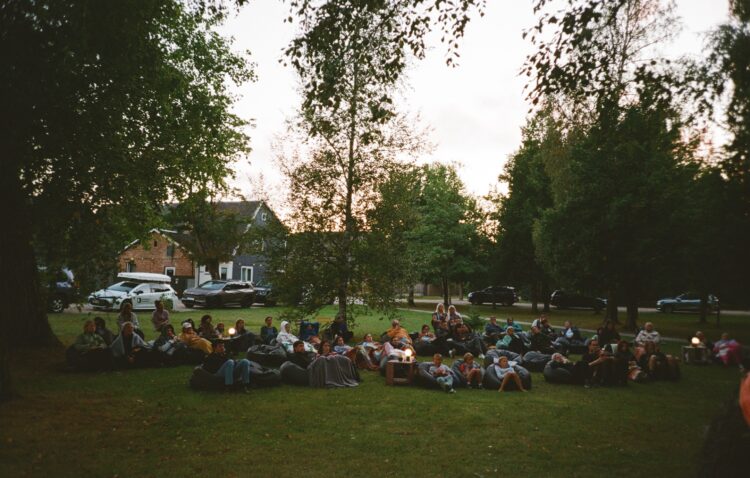
Nichols came to Riga during Riga Art Week 2026 as one of the international guests of the VV Foundation Visitors Programme, which introduces invited art professionals to Latvia’s contemporary art scene through encounters with artists, museums, galleries and artist-run spaces.
The Lyon Biennale takes as its point of departure the city’s traboules – a network of partly concealed passageways, courtyards and staircases through which Nichols explores movement, exchange and an expanded understanding of the economy, encompassing the circulation of attention, care, relationships and imagination. In this conversation, she outlines a curatorial approach in which listening precedes authorship and place is not a neutral framework, but an active force in shaping an exhibition. Nichols reflects on storytelling’s capacity both to reveal and to erase, on intuition as the outcome of sustained research, on the book as a continuation of an exhibition’s thinking, and on the museum as a field of relationships that must be continually reconsidered. The cultural spaces of the future, she argues, need to be open, welcoming and present not only within institutions, but also in streets, parks and other sites of everyday encounter.
From Manifesta 14 to the Lyon Biennale, your work often positions the curator less as an “author” and more as a mediator between people, places and different forms of knowledge. How do you balance listening and authorship in your curatorial process?
I think the idea of the curator as a creative mediator only really became clear to me when I was invited to curate Manifesta in Prishtina. The term “creative mediator” is one used specifically by Manifesta. Hedwig Fijen, its founding director, coined it to emphasise mediation over authorship, and that really shaped how I think about my role as a curator. Up until then, my curatorial practice had always involved mediating between texts, worlds and ways of thinking. Going to Prishtina made that approach, that role much more explicit.
Manifesta’s research-based approach meant that listening came first. Before thinking about artists or artworks, I had to ask: where am I? Who am I working with? What research am I building on? What are the desires of the people who live here? How do I, how does Manifesta understand those desires, and how might we work with them?
Learning about the city and its people, and about the histories of the venues where we would not only exhibit works but also develop them, became the point of departure. Only then did I begin to think about what kinds of images might emerge, what kind of narratives might unfold in those spaces.
From there, it became a process of developing a narrative out of what I had heard, and making proposals that I then discussed with the team and with people in Prishtina. I do think I have a strong sense of space and story, but it emerges from what I hear, from what I read and what I learn. Listening comes first. For me, authorship emerges from mediation.
Do you believe that a biennial can be built around a single curatorial vision?
As curators, we are always many. We are made up of the people we’ve read, the conversations we’ve had and the experiences that have shaped us. In that sense, no curatorial vision is ever entirely singular.
Curating is also collaborative by its very nature. Even if one person develops the initial concept, it evolves through dialogue – with artists, architects, writers, producers, conservators and many others. Those conversations don’t simply realise the exhibition; they shape it. My own approach has always been to listen carefully and to bring a multiplicity of voices, practices and forms of knowledge into relation with one another.
So yes, I do think a biennial can have a distinct curatorial vision, if by that we mean a way of bringing people together around a set of questions or concerns. That vision may be coherent, but it is never solitary. It emerges through dialogue, and it continues to change through the people who participate in it.
In your recent statement about the Lyon Biennale, you spoke about creating a biennial that is “situated and connected, audacious yet responsive.” What kind of biennial do you think is needed today? Can biennials still meaningfully engage with local realities while remaining international?
What’s needed today – as has always been the case – is a biennial that thinks. Or perhaps more precisely, a biennial that thinks with the place in which it finds itself. It should reflect on the format itself, ask what kinds of questions a biennial can open up and whether it is possible to think collectively.
I do think biennials can meaningfully engage with local realities while remaining international. For me, the two are inseparable. If you begin with the place, the people and the questions that emerge from them, you also begin to see how those questions resonate elsewhere.
That was my experience in Prishtina. We started with the city itself – its histories, its cultural scene and the people who lived there. The biennial grew out of questions around storytelling, cultural memory, erasure and reclaiming public space, while remaining deeply connected to concerns shared across many different places.
I’ve taken a very similar approach in Lyon. I began by trying to understand where I was, getting to know as many people as possible and listening carefully before developing the biennial. In Lyon, it’s the city’s history of circulation, trade and exchange that has become the point of departure. For me, that’s how an international biennial becomes situated: not by importing a theme, but by allowing the place to pose the questions to which the biennial responds.
And how did Lyon itself begin to shape the thinking of the biennial?
Lyon is quite different from Prishtina. Unlike Manifesta, the Lyon Biennale is not preceded by an urban vision, nor is it centred on discovering new sites or reactivating abandoned buildings. Most of the venues are already familiar parts of the biennial.
What I did discover, though, were the traboules – the hidden passageways that run through the city and shape its psychogeography. Once you begin to notice them – the discreet signs above doorways, the staircases and routes through buildings – you discover another geography beneath the visible city, one shaped by circulation, exchange and movement. Developed over centuries, they also speak of Lyon’s history of trade and industry.
What I find so compelling about the traboules is that they are liminal spaces, both literally and figuratively. They connect places, people and histories, but they also invite us to think about transition, permeability and exchange in a broader sense. That became one of the points of departure for the biennial.
The title of the biennial, To Pass from One Dream to Another, draws on Walter Benjamin’s idea of historical awakening – that fleeting moment when one world is dissolving and another is beginning to emerge. The traboules seemed to embody that idea. They offered a way of thinking with Lyon itself, and from there the biennial gradually began to unfold.
You work with spaces carrying strong histories or identities. What interests you in the relationship between art and place? Can a place shape an exhibition as much as an exhibition shapes a place?
Yes, for sure. I guess that’s already partially implicit in what I’ve been saying. If you allow a place to pose the questions to which the biennial responds, then the place inevitably shapes the exhibition. Places are never neutral containers. They carry histories, memories, desires and conflicts, and all of those become part of the curatorial process. They influence the kinds of works, conversations and encounters that can emerge there.
At the same time, exhibitions can shape places in very tangible ways. In Prishtina, some of the buildings that we reopened have continued to be used afterwards, although not always in the ways we had envisaged. People began to imagine new possibilities for them, and that, in itself, is already a form of transformation.
But I’m equally interested in the level of the imaginary. Art cannot erase history, nor should it. What it can do is bring forth new imaginaries, new memories and new possibilities. Petrit Halilaj’s work When the sun goes away, we paint the sky, on the roof of the Grand Hotel, has become a symbol of hope and of reclaiming the hotel, the ground and, perhaps, even the skies for the people of Prishtina. Petrit donated the work to the city, so it has become part of Prishtina’s skyline. But even when artworks are no longer there, they continue to live on in people’s minds, reshaping the way a place is remembered and imagined.
Storytelling seems to play an important role in some of your projects, especially Manifesta 14 and its idea of ‘telling stories otherwise’. But today storytelling has also become almost a cultural obsession. Does art risk romanticising storytelling? Where do you see its real power?
I wouldn’t say storytelling is a cultural obsession. I’d say it’s a fundamental part of human existence. We appear to one another through the stories we tell about ourselves and about the world. When I think about storytelling, I find myself returning to Hannah Arendt. For her, narrative is one of the ways a common world comes into being. Through storytelling, our actions acquire meaning, we disclose ourselves to one another and we begin to understand our place in the world.
That also means storytelling carries responsibility. Stories can erase just as easily as they can reveal. They can exclude, but they can also bring people together. They can reinforce existing structures of power, or they can open up new ways of imagining the future.
For me, that’s where the power of art lies. Not in romanticising storytelling, but in questioning dominant narratives, bringing overlooked stories into view and expanding our collective imagination. Art cannot change the world on its own, but it can bring forth new imaginaries and, perhaps, new ways of being together.
You’ve said that projects don’t feel complete without a book. What does writing allow you to do that exhibitions cannot?
I’m a writer more than a speaker, and writing is how I think. That’s also why I sometimes find interviews difficult. I love talking to people, but I don’t really think through talking. I think through writing and through placing things in relation to one another in space.
I mean, a book certainly documents what happened, allowing people to return to an exhibition long after it has closed. But it also becomes another space for thinking. By inviting other writers and voices into the project, it extends the exhibition into a different medium and another form of reflection.
I also simply love books as objects – their paper, their materiality, the tactile experience of reading. Bringing an exhibition into a book transforms it. It becomes another iteration of the exhibition, allowing you to encounter the ideas differently and to think through them again. A book doesn’t simply preserve an exhibition; it allows it to continue thinking in another form.
You once described your work as closer to “poetry and thought” than fixed art-historical categories. What role does intuition play in your process?
Well, I guess you could say that if you’re working through poetry and thought rather than fixed art-historical categories, then intuition inevitably becomes part of the process. Poetry is, after all, about bringing seemingly unrelated things into relation with one another. Curating often works in a similar way. That doesn’t mean abandoning research. Quite the contrary. I don’t see intuition as the opposite of research. Intuition emerges through immersion. The more deeply you engage with a subject, the more you begin to recognise unexpected affinities and patterns. A lot of curatorial work consists of following those intuitions – sensing that there may be a connection before you can fully explain it, and then testing that intuition through research.
I remember working on an exhibition about the Reformation, thinking about Martin Luther and the many figures who had responded to his ideas. For some reason, I had the intuition that Pier Paolo Pasolini might have had a relationship to Luther. I couldn’t have explained why. It was simply a feeling that there might be something there. So I followed it, and it turned out to be true.
That’s what fascinates me about curating. Intuition opens a path; research tells you whether it leads somewhere. Sometimes it doesn’t. But sometimes unexpected relations come into view, and the work is to understand why they are there. Those are the moments when thinking begins to resemble poetry.
At Hamburger Bahnhof, you work not only with temporary exhibitions, but also with collections and institutional memory. How can a museum collection remain alive and open in the 21st century? Can museums still surprise us?
I would say that a collection remains alive by staying open – by constantly being rethought, rearranged and placed in new relations. Collections should never become static. Every generation asks different questions of the works it inherits, and museums have a responsibility to keep opening themselves up for those conversations.
That’s something my colleagues and I have been thinking about a great deal at Hamburger Bahnhof. One of the things that interests me is bringing works from different historical moments and geographies into dialogue with one another. Showing Joseph Beuys in dialogue with Delcy Morelos, for example, doesn’t simply create a historical comparison. It allows people to think differently about subjectivity and agency, about ecology, materiality and the possibilities for establishing and maintaining a relationship with the earth. Suddenly, both practices can be seen differently – and in the case of Beuys, who has been on show at the museum for thirty years, to be seen again in a fresh light.
Surprise is central to that process. As I was saying before, one of the things I love about poetry is the way it brings things together that would not normally meet. Curating can do the same. By placing works, objects or ideas in unexpected relation to one another, museums can make us see familiar things differently. It reminds me of Viktor Shklovsky’s notion of estrangement – awakening our attention from the lethargy of habit. So yes, I do think museums can still surprise us. In fact, I think surprise is one of the conditions of thought. It captures our attention and allows us to encounter both artworks and collections afresh.
And I’m not afraid of beauty or of entertainment. They don’t preclude complexity. Something can be beautiful, engaging or entertaining while also being intellectually demanding and emotionally profound. I’ve always enjoyed bringing popular culture into exhibitions. Frank Sinatra songs, Donald Duck comics or other seemingly familiar cultural forms can open up entirely unexpected ways of thinking. They invite different audiences into the exhibition and create surprising dialogues with works that might, at first glance, seem very distant from them.
What kinds of cultural spaces will we need in the future?
Open ones, inviting ones. One of the most striking findings during the research for Manifesta was that a large majority of people in Prishtina considered the shopping mall to be the city’s most important cultural space. But in many ways Prishtina isn’t unusual in that respect. I live in Berlin, and I suspect the same could be said of probably many, if not all, other cities. Rather than dismissing that, I thought it was important to ask why. What is it about the shopping mall that makes people feel comfortable there? What kinds of needs is it fulfilling that cultural institutions are not? That’s a slightly uncomfortable question for museums, but it’s an important one. Those are questions cultural institutions should take seriously.
Museums remain incredibly important, but they are only one part of a much broader cultural ecology. They need to remain open – to new audiences, new forms of knowledge and new ways of experiencing art. At the same time, culture should also appear in streets, parks, shopping centres and all kinds of public spaces, where people already are and where they encounter it as part of their everyday lives.
One example I often think about is Ugo Rondinone’s intervention on the Monument of Brotherhood and Unity at Adem Jashari Square in Prishtina. Wrapping it in bright pink foil transformed not only the monument but the atmosphere around it. People gathered there as they always had – sitting in the pink light, eating ice cream and watching their children or grandchildren play. They talked about whether the Yugoslav monument should or shouldn’t exist in present-day Kosovo, whether it should or shouldn’t be pink, or simply about the weather and what they were having for dinner. The artwork didn’t resolve the questions it raised, nor was that its purpose. But for a while it transformed the monument into a place where people could simply be together – to talk, to disagree, to remember and to imagine what that place might become. To me, that says a great deal about what cultural spaces can be.
***
13.07.2026
Agnese Čivle
Original publication – Arterritory.com